
If you’ve been researching LED display technology, you’ve probably seen “Micro LED” and “Mini LED” mentioned everywhere. Most articles will tell you that Micro LED is smaller than Mini LED — but that barely scratches the surface.
The real difference starts at the most fundamental level: the LED chip itself. And that difference determines everything — what substrate it can use, who can manufacture it, and how the display performs.
In this article, I’ll walk you through the two key distinctions that actually matter:
- Chip size and structure — why Mini LED and Micro LED are fundamentally different chips
- Substrate and driving method — why the chip size determines the backplane AND how the display is driven, and why only a few players can make TFT-based Micro LED
Part 1: The Chip — It’s Not Just About Size
A Quick Background: How Traditional LEDs Are Made
To understand the difference between Mini LED and Micro LED, you first need to understand how a standard LED chip is built.
A conventional LED chip is grown on a sapphire substrate. Think of it like a cookie baked on a baking sheet — the sapphire substrate is the sheet, and the LED epitaxial layers are the cookie. The sapphire provides structural support during the manufacturing process.
This sapphire substrate stays attached to the LED chip throughout its life. It’s thick, rigid, and — critically — it takes up space.
Mini LED: Still Has the “Baking Sheet”
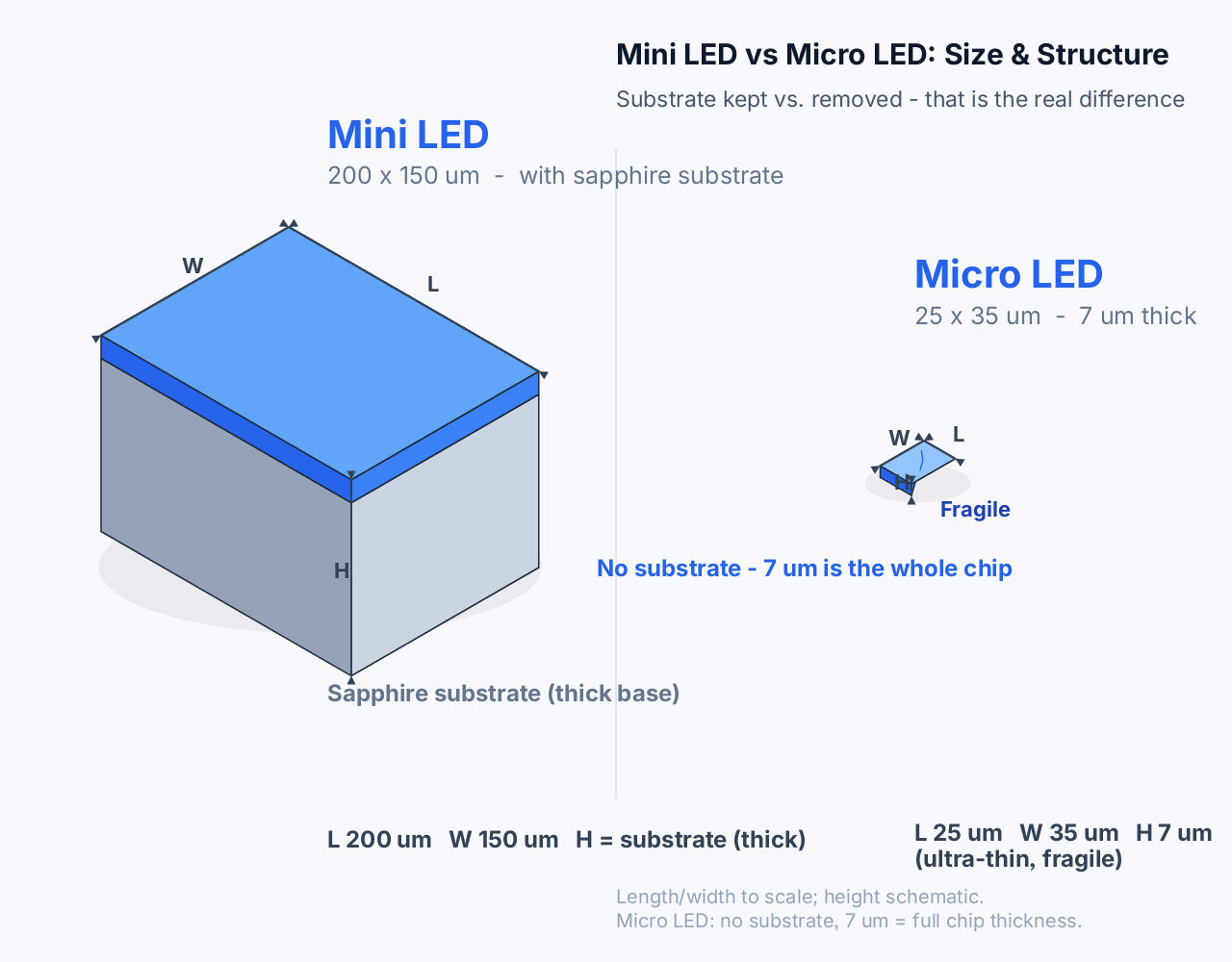
Mini LED chips are larger than 100µm (typically 100–200µm) and retain the sapphire substrate.
Because the chip is relatively large and the sapphire substrate is still attached, Mini LED chips are:
- Easier to handle during manufacturing
- More robust — the sapphire provides mechanical strength
- Compatible with existing PCB-based packaging — you can place them on traditional printed circuit boards using standard SMT (Surface Mount Technology) equipment
This is why Mini LED has been commercialized faster — the manufacturing process is an evolution of existing LED technology, not a revolution.
Micro LED: The “Baking Sheet” Is Removed
Micro LED chips are smaller than 100µm (typically 20–80µm) and the sapphire substrate is removed.
This is the critical distinction that most comparison articles miss. When you remove the sapphire substrate, the chip becomes:
- Extremely thin — just the epitaxial layers, no substrate
- Extremely fragile — like a crispy cracker without the baking sheet underneath
- Impossible to handle with traditional methods — you can’t just pick and place these chips like Mini LED
Without the sapphire, the Micro LED chip is essentially a bare, ultra-thin semiconductor film. This is what makes the “mass transfer” process so challenging — you need to move millions of these microscopic, fragile chips onto a display backplane with near-perfect precision.
The Chip Size Comparison
| Dimension | Mini LED | Micro LED |
|---|---|---|
| Chip size | > 100µm | < 100µm |
| Sapphire substrate | ✅ Retained | ❌ Removed |
| Chip thickness | Thick (with substrate) | Ultra-thin (substrate removed) |
| Mechanical strength | Robust | Fragile (like a crispy cracker) |
| Handling method | Standard pick-and-place | Mass transfer (specialized) |
| Manufacturing maturity | Large-scale commercial | Early commercial stage |
Key insight: The size difference (100µm threshold) isn’t arbitrary. Below 100µm, the sapphire substrate becomes a problem — it’s too thick relative to the chip, making the chip impossible to use in fine-pitch displays. That’s why removing the substrate is necessary, and that’s what fundamentally separates Micro LED from Mini LED.
Part 2: The Substrate and Driving Method — A Complete Paradigm Shift
Here’s where it gets really interesting — and where most buyers get confused.
Moving from Mini LED to Micro LED isn’t just about changing the substrate. It changes the entire driving architecture — how the display is powered and controlled.
Why Mini LED Uses PCB + Individual Driver ICs
Mini LED chips, with their sapphire substrate still attached, are relatively large and robust. They can be mounted on PCB (Printed Circuit Board) substrates using standard manufacturing processes.
The driving method is straightforward: each LED chip (or a small group of chips) has its own dedicated driver IC mounted on the PCB behind it. Think of it like a house where every room has its own light switch wired directly to the light.
Traditional LED Driving Architecture:

  Driver IC → LED chip(s)
  Driver IC → LED chip(s)
  Driver IC → LED chip(s)
  Driver IC → LED chip(s)
  ... (one driver IC per chip or per small group)
PCB is:
- Widely available
- Affordable
- Easy to work with
- Compatible with existing LED display manufacturing lines
This is why most Mini LED displays on the market use PCB substrates. Any LED display factory can make them.
Why Micro LED Needs TFT — And a Completely Different Driving Method
When you shrink the chip below 100µm and remove the sapphire substrate, PCB can no longer do the job. Here’s why:
- PCB has thermal expansion issues — under heat, PCB warps, which causes misalignment at the microscopic level. With chips this small, even tiny warping means visible defects.
- PCB can’t achieve the required precision — for pixel pitches below P1.0, you need sub-micron alignment accuracy that PCB manufacturing can’t deliver.
- PCB’s surface flatness is insufficient — Micro LED chips are fragile and thin. Any unevenness on the substrate surface will crack them.
TFT glass substrate solves all three problems:
- Low thermal expansion — glass stays flat and stable under heat
- Sub-micron precision — TFT manufacturing achieves the alignment accuracy needed for Micro LED
- Perfect surface flatness — glass provides a perfectly smooth surface for those fragile chips
But here’s the part that’s even more important — and rarely discussed: the TFT backplane completely changes how the display is driven.
The Driving Revolution: External Driver IC Instead of Individual Driver ICs
Because TFT-based Micro LED uses a TFT backplane (just like LCD and OLED panels), the driving method is fundamentally different from traditional LED displays.
Instead of placing one driver IC per LED chip or per small group, TFT-based Micro LED uses just one external driver IC to drive an entire TFT panel. For tiled displays (multiple panels spliced together), you may need a few — one per panel plus a coordination IC — but the principle is the same: a handful of ICs replaces hundreds or thousands.
TFT-Based Micro LED Driving Architecture:

  1 External Driver IC → 1 TFT Panel → All Micro LED pixels on that panel
                                              ↓
                         TFT acts as a switching matrix
                         Just ONE driver IC controls the entire panel

  For tiled displays (e.g., 2×2 panels):
  Driver IC → Panel 1
  Driver IC → Panel 2
  Driver IC → Panel 3
  Driver IC → Panel 4
  (Still just a few ICs, not hundreds)
Think of it this way: instead of having a light switch in every room, you have a smart home control panel — one central controller that can turn any light on or off through the wiring network (the TFT matrix).
This is exactly how LCD and OLED panels work. The TFT backplane acts as an active matrix — each pixel has its own TFT switch, and the external driver IC sends signals through the TFT matrix to address each pixel individually.
Why This Matters: Saving Chips and Cutting Costs
| Traditional PCB LED | TFT-Based Micro LED | |
|---|---|---|
| Driver ICs needed | One per chip or per small group | Just 1 external driver IC per panel (a few for tiled displays) |
| Driver IC count | Hundreds or thousands | 1 per panel (a few for tiled displays) |
| Cost of driver ICs | Major cost component | Dramatically reduced |
| Complexity | High — many ICs to manage | Lower — centralized control |
| Panel thickness | Thicker (ICs behind each chip) | Thinner (no ICs on the backplane) |
In a traditional LED display, driver ICs are one of the most expensive components. For a large-format LED wall, you might need hundreds or thousands of driver ICs. In a TFT-based Micro LED display, you only need one driver IC per panel because the TFT backplane handles the pixel-level switching. For a tiled display, you need one per panel plus a coordination IC — still just a handful compared to hundreds.
The cost reduction on driver ICs is massive. This is one of the most overlooked advantages of TFT-based Micro LED — as production scales, the IC savings alone can significantly bring down the total cost of ownership.
TGV: Another Glass-Based Approach (But Different)
There’s another glass-based Micro LED technology worth mentioning: TGV (Through Glass Via).
TGV involves drilling microscopic holes through the glass substrate and filling them with conductive material to create vertical interconnects — similar to how PCBs use through-holes, but through glass instead.
TGV (Through Glass Via):

  Driver ICs are still individually placed
  But the substrate is glass instead of PCB
  Vertical connections go through the glass
TGV vs TFT-based driving — what’s the difference?
| TFT-Based (AM Driving) | TGV-Based | |
|---|---|---|
| Driving method | External driver IC → TFT matrix → pixels | Individual driver ICs (like traditional PCB) |
| Glass role | Glass is the active backplane (with TFT circuits) | Glass is just a passive substrate (replaces PCB) |
| Driver IC count | Few (external only) | Many (still one per chip group) |
| Cost advantage | ✅ Saves driver ICs | ❌ Still needs many driver ICs |
| Manufacturing complexity | High (requires TFT fab) | Moderate (glass drilling + traditional assembly) |
| Maturity | Early commercial | Limited by glass drilling yield |
In short: TGV replaces PCB with glass to solve the thermal and flatness problems, but it doesn’t change the driving architecture — you still need individual driver ICs. TFT-based Micro LED solves both the substrate problem AND the driving problem, making it the more advanced (though more challenging to manufacture) approach.
TGV’s biggest challenge is yield. Drilling microscopic holes through glass is inherently tricky — glass is brittle, and the drilling process can cause cracks and defects. This low yield rate directly drives up TGV’s cost, making it less competitive than TFT-based approaches for now.
Who Can Make TFT-Based Micro LED?
This is where the industry landscape gets interesting. TFT substrate manufacturing is an entirely different business from LED display manufacturing. You need a TFT fab — and that requires billions of dollars in investment.
The players who can produce TFT-based Micro LED are limited to:
| Region | Key Players | Background |
|---|---|---|
| China | BOE, Visionox (辰显光电), TCL CSOT | Leveraging LCD panel manufacturing infrastructure |
| Japan | Sharp, Sony | Mature LCD/OLED panel heritage |
| Korea | Samsung, LG | Dominant in OLED, transitioning to Micro LED |
Why Japan and Korea are limited: Japan and Korea’s TFT substrate expertise comes from their LCD panel manufacturing. However, their LCD business has been declining as China aggressively expands LCD capacity. This means:
- Japan and Korea’s TFT fabs are increasingly repurposed for OLED production, not Micro LED
- Their Micro LED development is constrained by the need to keep OLED lines running
- China, on the other hand, has newer TFT fabs and can dedicate capacity to Micro LED
Why China has an advantage:
- China has the world’s largest LCD panel manufacturing capacity
- These LCD fabs can be upgraded for Micro LED TFT substrate production
- Chinese companies like BOE and Visionox are already shipping TFT-based Micro LED products
- Government support for Micro LED as a strategic technology
- Chinese domestic driver ICs are already entering production — this is critical. Since TFT-based Micro LED only needs one driver IC per panel, the barrier to entry for driver IC suppliers is lower. Chinese semiconductor companies are now producing qualified driver ICs for TFT-based Micro LED, which further reduces cost and eliminates dependence on foreign IC suppliers
The Complete Comparison: Substrate + Driving Method
| Dimension | PCB Substrate | TFT Glass Substrate | TGV Glass |
|---|---|---|---|
| Used by | Mini LED | Micro LED (advanced) | Micro LED (alternative) |
| Driving method | Individual driver ICs | External driver IC + TFT matrix | Individual driver ICs |
| Driver IC count | Hundreds/thousands | A few | Hundreds/thousands |
| Cost advantage | Standard | ✅ Saves driver ICs | Standard |
| Thermal stability | Prone to warping | Excellent | Excellent |
| Surface flatness | Moderate | Perfect — seamless splicing | Perfect |
| Seam visibility | Visible seams | Invisible seams | Invisible seams |
| Manufacturing cost | Low | High (TFT fab required) | Moderate |
| Available suppliers | Many (any PCB factory) | Few (panel manufacturers only) | Very few |
| Display size limit | Practical for most sizes | Ideal for large-format (100″+) seamless | R&D stage |
So, Which One Should You Choose?
Choose Mini LED if:
- You need a display now — Mini LED is mature and widely available
- Your application doesn’t require pixel pitch below P1.0
- Budget is a primary concern
- You’re using the display at normal viewing distances (3m+)
Choose Micro LED (TFT-based) if:
- You need ultra-fine pixel pitch (P0.4–P0.9) for close-up viewing
- You need a seamless large-format display — no visible seams between panels
- You want the highest possible image quality — perfect blacks, infinite contrast, no burn-in
- Your application is in control rooms, high-end retail, or premium conference rooms where visual perfection matters
Frequently Asked Questions
Q: Is Micro LED better than Mini LED?
A: “Better” depends on your application. Micro LED offers superior image quality and seamless large displays, but it’s more expensive and less mature. Mini LED is more practical for most commercial applications today.
Q: Why is Micro LED so expensive?
A: Two reasons: the mass transfer process (placing millions of microscopic chips with near-perfect accuracy) is extremely difficult, and TFT substrates are only available from panel manufacturers, which limits supply.
Q: Can Micro LED replace OLED?
A: For large-format displays, yes — Micro LED has no burn-in risk, higher brightness, and longer lifespan. For small consumer devices (phones, watches), OLED remains more cost-effective for now.
Q: Why does removing the sapphire substrate matter?
A: Without the substrate, the chip becomes ultra-thin and can be placed on TFT glass substrates, enabling seamless displays with pixel pitches below P1.0. With the substrate, the chip is too thick for fine-pitch applications.
Q: What’s the difference between TFT driving and TGV in Micro LED?
A: TFT-based Micro LED uses an external driver IC to drive the TFT backplane, which then switches each pixel — similar to how LCD/OLED panels work. This saves a huge number of driver ICs, reducing cost. TGV (Through Glass Via) replaces PCB with glass but still uses individual driver ICs behind each chip group — it solves the substrate problem but not the driving problem.
Q: Does TFT-based Micro LED really save cost?
A: Yes — the savings on driver ICs are massive. Traditional LED displays need hundreds or thousands of driver ICs (one per chip group). TFT-based Micro LED needs only one driver IC per panel. As production scales, this chip-saving advantage becomes increasingly significant. Chinese domestic driver ICs are already entering production, which will further drive down costs.
Whether you need Mini LED, Micro LED, COB, or SMD — we can help you find the right solution for your project. We specialize in TFT-based Micro LED displays and also offer a full range of LED display products.
Contact us for a free consultation and quote
Explore related solutions: Our 20-inch transparent Micro LED and TFT glass-based Micro LED show where the technology is headed — explore solutions.